Economic data is only as trustworthy as its provenance.
An observation may tell us what happened. Metadata tells us where that information came from, who produced it, and how it should be interpreted.
As RESERVE has evolved, an increasingly important design principle has emerged: metadata should not be treated as secondary information. Source attribution, citation requirements, and dataset provenance are part of the data itself.
Version 1.1.6 continues that philosophy by improving attribution fidelity throughout the platform, strengthening support for multi-source datasets, and expanding structured metadata for both human and agent-driven workflows.
Economic Data Often Has Multiple Sources
Many users think of a series as having a single producer.
In reality, economic datasets are often assembled from multiple contributing organizations. A published series may represent work performed by several agencies, institutions, or data providers.
Representing that relationship accurately becomes increasingly important as data moves through analytical pipelines.
Version 1.1.6 expands RESERVE’s metadata model to support:
Multiple source attributions per series
Structured source name arrays
Normalized citation display names
Richer source metadata in release payloads
These additions ensure attribution information can remain complete even when a dataset’s provenance extends beyond a single organization.
Clear Attribution for Multi-Series Workflows
As support for comparative and multi-series analysis has grown, citation presentation has become more challenging.
A single observation query may involve several series, each with different attribution requirements and source organizations.
Previous releases consolidated citations where possible. Version 1.1.6 takes the next step by providing per-series source attribution blocks for multi-series observation output.
This approach prioritizes clarity over brevity.
When multiple datasets appear together, users should be able to determine exactly which sources contributed to each series without ambiguity.
Single-series workflows retain concise source presentation, while multi-series output now emphasizes attribution precision.
Better Metadata for Downstream Systems
Increasingly, RESERVE serves as more than an interactive command-line tool.
Outputs are consumed by:
Scripts
Pipelines
Dashboards
Analytical workflows
AI systems
To support these use cases, release metadata payloads now expose complete structured source information through JSON interfaces.
Commands such as release metadata retrieval now include full source arrays, allowing downstream systems to preserve attribution information without relying on human-readable formatting.
The objective is straightforward:
Source metadata should be available as structured data whenever possible.
Building for Human and Agent Consumers
One of the more notable additions in v1.1.6 is expanded onboarding metadata intended for automated consumers.
Structured onboarding payloads now include information such as:
Primary audience
Human versus agent targeting
Explicit content classification
These additions help language models and automation systems better understand the purpose and intended usage of onboarding materials.
While subtle, this reflects an increasingly important reality: modern software documentation is consumed by both people and machines.
Supporting both audiences requires metadata that clearly communicates intent.
Improving Attribution Quality
Several refinements in this release focus on the presentation and consistency of source information.
Citation display names are now normalized when upstream metadata is provided in inconsistent formats.
Duplicate source footers are eliminated for shared datasets.
Serialization edge cases involving incomplete attribution records have been addressed.
These improvements may appear minor, but they contribute to a larger goal: ensuring attribution remains accurate, readable, and reliable regardless of where the data originated.
Metadata Is Not an Afterthought
A recurring theme throughout recent RESERVE releases has been responsible data stewardship.
Permissions matter.
Citations matter.
Provenance matters.
Version 1.1.6 extends that philosophy by improving how source information is represented, preserved, and communicated throughout the platform.
Economic observations are the most visible part of a dataset.
But understanding who produced those observations—and ensuring that information survives every step of the workflow—is equally important.
In RESERVE, metadata is no longer treated as an accessory to the data.
It is part of the data.
And v1.1.6 continues the work of making sure it stays that way.
But buried deep inside a relatively obscure U.S. Bureau of Labor producer-price series may be an entirely different inflation story — one that could define the next decade of enterprise economics.
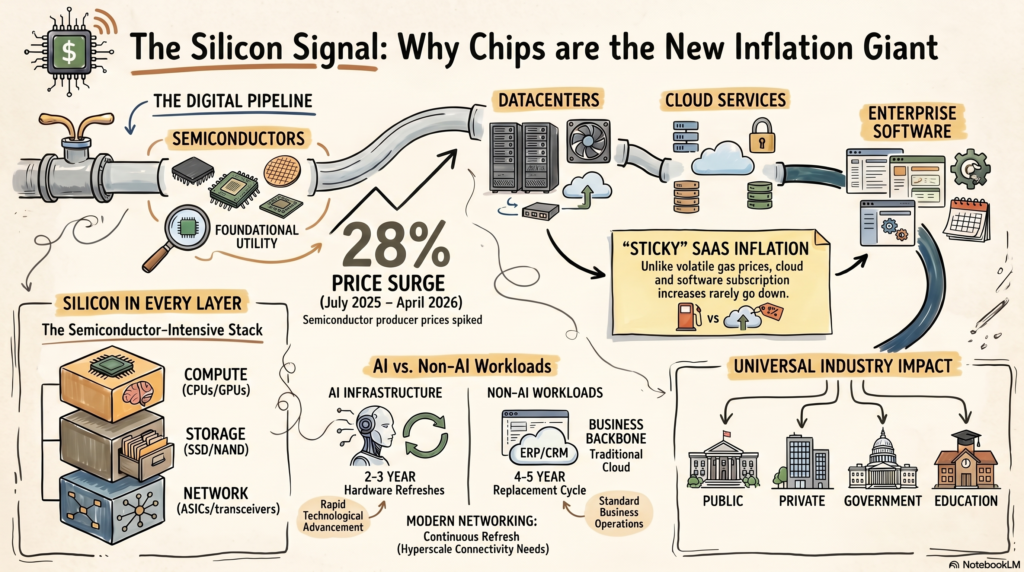
The number is semiconductor and electronic component producer pricing .
And it may be flashing a warning that almost nobody is talking about.
The Data Nobody Is Looking At
The producer price index for semiconductors and electronic components is most easily accessed through the Federal Reserve Bank’s FRED® platform (series ID PCU3344133441). Upon review, the data looked almost boring through most of 2025.
For months, prices barely moved. Then something changed. By August 2025, prices began climbing. By early 2026, they exploded.
From the July 2025 low to April 2026, semiconductor and electronic component producer prices surged nearly 28%.
That is not the kind of inflation shock typically tied to oil tankers drifting through the Strait of Hormuz or temporary commodity volatility. It is a structural repricing event — one most observers would immediately attribute to the AI gold rush. And they are probably partially correct.
But the implications may reach far beyond AI accelerators themselves.
Semiconductors are no longer just components inside consumer electronics. They are rapidly becoming the foundational infrastructure layer beneath cloud computing, enterprise software, logistics systems, financial platforms, industrial automation, and increasingly the broader economy itself.
If the economics of compute are changing, then the inflation story may be changing with them.
Economists May Be Looking in the Wrong Place
Traditional inflation models were built around industrial-era economics. The classic inflation pipeline looked like this:
Energy -> Transportation -> Manufacturing -> Consumers
That framework makes sense for a physical economy dominated by: fuel, shipping, factories, and commodity production. But the modern economy runs on something else. Increasingly, the real pipeline looks like this:
Semiconductors & Electronics -> Datacenters -> Cloud Services -> Enterprise Software -> Every Industry
This is the inflation architecture of a digital economy. And it changes everything.
Compute Has Become a Foundational Industrial Input
For decades, technology was deflationary. Compute, storage, and bandwidth consistently got cheaper. Infrastructure as a Service (IaaS) and Software as a Service (SaaS) promoted lower total cost of ownership and operational efficiency as core selling points. In many cases that promise proved true. In others, it simply shifted costs from internal IT departments into recurring vendor contracts.
What the broader cloud industry unquestionably established, however, was the normalization of annual price increases embedded inside multi-year customer commitments.
For years, none of this appeared dangerous because the underlying economics of technology remained deflationary. The market internalized the idea that technological progress naturally lowers costs over time.
But what if that assumption is beginning to break?
Part of the answer may lie in how the architecture of cloud infrastructure itself has changed.
Historically, the industry treated compute, storage, and bandwidth as distinct infrastructure categories:
compute meant CPUs and servers,
storage meant hard drives and storage arrays,
bandwidth meant fiber and networking equipment.
Today, all three increasingly collapse into one semiconductor and electronic component intensive stack.
Compute is obviously driven by CPUs, GPUs, accelerators, and memory. But storage is now dominated by NAND flash and SSD controllers. Even bandwidth is no longer “just fiber.” Modern hyperscale networking depends on switching ASICs, optical transceivers, packet processors, NICs, DSPs, and routing silicon. The intelligence layer of the modern internet is semiconductor-driven.
The result is that cloud infrastructure has quietly become an enormous assembly of semiconductor and electronic component based systems connected by glass.
And cloud infrastructure is no longer a niche industry. It is becoming the operational backbone of the global economy.
Payroll systems, logistics platforms, ERP software, CRM systems, healthcare infrastructure, and financial platforms now run inside hyperscale datacenters. These are not speculative AI workloads. They are ordinary, everyday business operations that increasingly depend on semiconductor-intensive infrastructure.
This matters because hyperscalers are entering a perpetual hardware replacement cycle.
That is why a sustained rise in semiconductor and electronic component producer prices matters. If these input costs remain elevated — or continue rising — the effects will eventually work their way through the cloud stack itself, placing upward pressure on SaaS, IaaS, AI inference, and enterprise software pricing.
Not immediately. Hyperscalers hedge aggressively, negotiate long-term supply contracts, and amortize infrastructure investments over years. But producer-price inflation at the hardware layer rarely disappears permanently. Eventually, it surfaces somewhere in the economics of the digital economy.
The Economics Nobody Wants to Talk About
When people discuss AI infrastructure, they focus on model capabilities.
But the economic story is much larger. Google Cloud recently reported:
$20 billion in quarterly revenue,
63% year-over-year growth,
A staggering $462 billion contract backlog
That backlog may be the most important number.
Why?
Because it signals that corporations are committing themselves to long-duration cloud dependence.
These are not experimental workloads or simple eliminations of “server closets” anymore. Cloud infrastructure is becoming mandatory infrastructure. And mandatory infrastructure eventually gains pricing power.
The Replacement Cycle Problem
The semiconductor story becomes even more interesting once you examine hardware replacement cycles. Traditional enterprise servers were typically replaced every 4–5 years. That cycle roughly holds true for the racks of compute infrastructure that powers IaaS and SaaS offerings. AI infrastructure may need replacement every 2–3 years — possibly even faster. The result has been and will continue to be growing and persistent semiconductor demand. Not cyclical demand. Not temporary demand. Permanent demand.
What Happens If Compute Stops Being Deflationary?
This is the macroeconomic question sitting quietly beneath the surface of the semiconductor data. What happens if compute itself becomes inflationary?
The Bureau of Labor Statistics has been tracking Semiconductor as a separate price index since 1984. For those who lived it, you remember the story as prices came down and the economy digitized. The financial crisis of 2008 did not have material impact nor did the post COVID recovery era.
Enter late 2025 and the start of 2026 and semiconductor returns to mid-2000 levels as if it went through an overnight time machine! The difference is that the number of business critical corporate and government workloads that have been migrated to the cloud in the last 20 years has been exponential.
To net it out, rising semi-conductor costs lead to rising cloud infrastructure cost. These costs are the inputs that will drive up SaaS software operating costs and find their way financials just about every sector of the economy both private and public.
The result is a new kind of inflation transmission mechanism. This will not taking place through gasoline pumps but through recurring software invoices. And unlike commodity spikes, SaaS inflation is sticky. Once enterprise subscription pricing rises, it rarely falls.
The New Inflation Utility
Electricity became a universal industrial utility in the 20th century. Compute may be becoming the equivalent utility of the 21st century. If so, semiconductors are no longer just components. They are upstream economic infrastructure. Which means semiconductor pricing may increasingly behave less like a cyclical technology sector and more like a foundational inflation input.
That possibility is hiding in plain sight inside the producer-price data. Yet, the news headlines are still talking about the price of diesel. The next inflation giant may already be sitting quietly inside the datacenter.
As software matures, progress increasingly comes from refinement rather than expansion.
New features remain important, but long-term usability often depends on something less visible: consistency. Users should be able to trust that commands behave predictably, that metadata is presented correctly, and that edge cases are handled without surprises.
Version 1.1.5 focuses on exactly those areas.
This release improves alias management, strengthens citation presentation, resolves structured output edge cases, and closes several correctness gaps discovered during real-world usage.
Together, these changes make RESERVE a more reliable platform for everyday economic data workflows.
Aliases Gain Context
Aliases have always provided a convenient way to create memorable shortcuts for frequently used series.
With v1.1.5, aliases become more than simple mappings.
Users can now attach optional notes when creating aliases:
reserve alias set CPI CPIAUCSL --note "Headline CPI inflation"
Alias metadata now supports:
Required series identifiers
Optional user-authored notes
Richer listing and display behavior
The result is a lightweight documentation layer that allows users to capture intent directly alongside their shortcuts.
As collections of aliases grow, that additional context becomes increasingly valuable.
A name can tell you what something is.
A note can remind you why it matters.
Citations Should Be Predictable
Previous releases introduced citation-aware data handling as part of RESERVE’s broader commitment to responsible economic data stewardship.
Version 1.1.5 continues that effort by improving how citations are presented across observation commands.
Table output now uses a consistent citation model:
Single-source results produce a single Source footer
Multi-source results produce a consolidated Sources footer
Duplicate source entries are automatically removed
Most users will simply notice cleaner output.
More importantly, citation behavior is now predictable regardless of whether a workflow involves one series or many.
Consistency reduces ambiguity and helps ensure attribution remains visible as analysis becomes more complex.
Structured Output Should Stay Structured
One of the most important fixes in this release addresses a subtle but significant interoperability issue.
Certain economic series contain missing observations represented internally as NaN values.
When exported as JSON, these values could previously trigger errors such as:
json: unsupported value: NaN
Version 1.1.5 now converts missing observation values to JSON null.
This change aligns RESERVE output with standard JSON expectations and improves compatibility with downstream tools, scripts, databases, and AI workflows.
The principle is straightforward:
Structured output should remain valid structured output, even when the underlying data contains gaps.
Stronger Alias Ownership Semantics
Several fixes in this release improve how aliases behave across local and user-level configuration files.
Alias deletion now correctly removes entries from the configuration file that actually owns the alias, avoiding situations where merged configuration views could make ownership unclear.
Collision detection has also been strengthened.
When upstream validation services experience transient failures, alias creation now fails closed rather than assuming success.
These changes prioritize correctness over convenience and help prevent subtle configuration inconsistencies from accumulating over time.
Preserving Compatibility
As configuration models evolve, existing users should not be forced into disruptive migrations.
To support that goal, RESERVE now tolerates legacy string-based alias definitions during reads while continuing to write the newer structured format.
This allows older configurations to remain functional while gradually moving users toward the canonical representation.
The migration path becomes effectively automatic.
Small Improvements, Bigger Reliability
Many releases are remembered for a single headline feature.
Version 1.1.5 is different.
Its value comes from dozens of small improvements that collectively strengthen the user experience.
Aliases now carry richer context.
Citation behavior is more consistent.
Structured outputs are more reliable.
Configuration ownership is clearer.
Compatibility is stronger.
None of these changes dramatically alter what RESERVE can do.
They improve confidence in how RESERVE does it.
And for a tool intended to support serious economic analysis, that confidence matters.
Ground beef comes in a wide range of varieties, with pricing influenced by factors such as fat content, grading quality, and premium options like grass-fed beef. Every one of these characteristics affects the final retail price consumers see at the grocery store.
Historically, ground beef prices have moved in cycles, rising and falling alongside broader commodity markets, cattle supply, feed costs, transportation expenses, and consumer demand. But in recent years, something has clearly changed. The long-term trend no longer looks cyclical—it looks relentless. Prices keep climbing, and consumers are feeling it every time they walk through the meat aisle.
What was once considered one of the most affordable and dependable protein options for American families is rapidly becoming another example of persistent food inflation. And according to the data, this isn’t just perception—it’s measurable reality.
Ground Beef Price Data
Two Federal Reserve Economic Data (FRED) series publish monthly average retail pricing data for ground beef:
“Average Price: Ground Beef, Lean and Extra Lean” (APU0000703113)
These datasets provide a long-term view into how dramatically retail beef prices have changed over time. One of the easiest ways to locate the series is by using the FRED search function or RESERVE search command:
This search reveals these two series along with other related commodity oriented data series.
Examining the Trend
Price increases are best understood visually. While these series can certainly be exported into a spreadsheet for graphing and further analysis, RESERVE already provides both a powerful transform command set and built-in ASCII charting capabilities.
The transform commands are especially useful for converting raw data into a more macro-level view of the underlying trend. Since both ground beef datasets are published monthly, aggregating the data into quarterly or yearly intervals provides a much clearer picture of the long-term direction of prices while reducing short-term noise.
One of RESERVE’s strengths is composability. The results from the original search can be passed directly into the transform command set and then piped into the charting commands for visualization. The result is shown below:
The grade-school explanation for rising prices usually simplifies inflation down to basic supply and demand. In reality, modern economies are tightly interconnected ecosystems where countless variables interact simultaneously—each with its own supply constraints, demand pressures, and downstream effects.
Ground beef prices are a perfect example. Retail pricing is influenced not only by consumer demand, but also by cattle inventory levels, feed costs, fuel prices, transportation expenses, labor markets, interest rates, weather conditions, and even import/export dynamics. Every layer of the supply chain contributes pressure to the final price consumers see at the grocery store.
One of the strengths of the FRED system is that this data is publicly accessible for both hobbyists and researchers to explore. For anyone interested in understanding the forces driving the long-term rise in ground beef prices, RESERVE search makes it possible to discover and analyze datasets covering everything from hay and diesel costs to cattle inventories, beef production, and international trade flows.
Marketplace, the popular economics podcast, has built a reputation for making complex economic topics accessible to everyday listeners. Much of that appeal comes from host Kai Ryssdal, whose mix of sharp insight, humor, and storytelling makes even the driest data surprisingly entertaining.
On May 7, 2026, the Marketplace episode contained a segment titled “Measuring Economic Demand.” The episode focused on a lesser-known economic indicator — Final Sales to Private Domestic Purchasers. The point was to explain why economists often view it as a cleaner measure of underlying demand than headline GDP.
This post picks up where Marketplace left off. Using RESERVE, readers can explore the data themselves, track the series over time, and dig deeper into the economic story behind the numbers.
The segment also sparked an idea for a new RESERVE feature — one I’ll introduce at the end of this post.
What Did Kai Actually Say
In the Marketplace segment, Kai Ryssdal walked listeners through the basic building blocks of Gross Domestic Product (GDP): consumer spending, business investment, government spending, and net exports.
Then, in classic Kai fashion, he slowed things down and carefully unpacked a lesser-known measure: Final Sales to Private Domestic Purchasers.
At its core, the metric strips away some of GDP’s noisier components — namely net exports, government spending, and inventory swings. The intent is to focus more directly on underlying private-sector demand in the U.S. economy.
Rather than using the finalized quarterly GDP reports, the segment focused on the advance estimates, the first look economists get at quarterly economic growth data.
To find this series in RESERVE, use the following search command:
reservesearch"Final Sales to Private"Searchresultsfor:"Final Sales to Private"+--------------------+----------------------------------------------------+------+----------------------+------------------------+|ID|TITLE|FREQ|UNITS|LASTUPDATED|+--------------------+----------------------------------------------------+------+----------------------+------------------------+|LB0000031Q020SBEA|RealFinalSalestoPrivateDomesticPurchasers|Q|Bil.of2017US $ |2026-04-3007:48:54-05||PB0000031Q225SBEA|Realfinalsalestoprivatedomesticpurchasers|Q|%Chg.fromPrece...|2026-04-3007:48:33-05||PE0000031Q156NBEA|RealFinalsalestoprivatedomesticpurchasers|Q|%Chg.fromQtr....|2026-04-3007:48:30-05||PB0000031A225NBEA|Realfinalsalestoprivatedomesticpurchasers|A|%Chg.fromPrece...|2026-03-1307:49:16-05||LA0000031Q027SBEA|FinalSalestoPrivateDomesticPurchasers|Q|Bil.of $ |2026-04-3007:49:20-05||LA0000031A027NBEA|Finalsalestoprivatedomesticpurchasers|A|Bil.of $ |2026-04-0907:53:06-05||FINSALESDOMPRIVPUR|NowcastforRealFinalSalesofPrivateDomesti...|Q|%Chg.atAnnual...|2026-05-0811:02:58-05||GOR|GrossOutputbyIndustry:RetailTrade|Q|Bil.of $ |2026-04-0907:34:48-05||A811RC2Q027SBEA|Ratiosofprivateinventoriestofinalsalesof...|Q|%|2026-04-3007:50:53-05||PA0000031Q225SBEA|Finalsalestoprivatedomesticpurchasers,cur...|Q|%Chg.fromPrece...|2026-04-3007:48:25-05||PA0000031A225NBEA|Finalsalestoprivatedomesticpurchasers,cur...|A|%Chg.fromPrece...|2026-02-2007:46:57-06|
The series ID for the quarterly updated version of Real Final Sales to Private Domestic Purchasers is PB0000031Q225SBEA . Note, that if this series is examined with the META SERIES command and formatted in JSON, RESERVE will give the user almost verbatim Kai’s explanation (minus the humor). See the NOTES field for the definition.
reservemetaseriesPB0000031Q225SBEA--formatjson{"kind":"series_meta","generated_at":"2026-05-09T15:54:44.926228-05:00","command":"meta series PB0000031Q225SBEA","data": [{"id":"PB0000031Q225SBEA","title":"Real final sales to private domestic purchasers","observation_start":"1947-04-01","observation_end":"2026-01-01","frequency":"Quarterly","frequency_short":"Q","units":"Percent Change from Preceding Period","units_short":"% Chg. from Preceding Period","seasonal_adjustment":"Seasonally Adjusted Annual Rate","seasonal_adjustment_short":"SAAR","last_updated":"2026-04-30 07:48:33-05","popularity":38,"notes":"BEA Account Code: PB000003\n\nFinal sales to domestic purchasers less government consumption expenditures and gross investment. \nA Guide to the National Income and Product Accounts of the United States (NIPA) - (http://www.bea.gov/national/pdf/nipaguid.pdf)","source_name":"Bureau of Economic Analysis","copyright_status":"public_domain_citation_requested","citation_text":"Source: Bureau of Economic Analysis via FRED","usage_allowed_commercial":true,"usage_allowed_educational":true,"usage_allowed_personal":true,"raw_rights_tags": ["public domain: citation requested" ],"last_rights_check_at":"2026-05-09T20:53:26.738003Z","fetched_at":"2026-05-09T20:53:26.738011Z"} ],"stats":{"cache_hit":false,"duration_ms":0,"items":1}}
Also note in the original search that pulling data from the affiliated series PB0000031Q225SBEA will provide the percentage change since last published series which is that 2.5% number Kai referenced.
The point of this exercise is that podcast like Marketplace offer incredible insight and perspective on economics data. If a listener finds this interesting, they can use RESERVE and their free API key from FRED® to explore the topic even further. That is the point of RESERVE–lowering the barrier of entry to the over 800 data series made accessible by the Federal Reserve Bank of St. Louis.
What Upcoming Feature Did Kai Inspire?
In Kai fashion, he spoke the words “Final Sales to Private Domestic Purchasers” very slowly. Why? It’s a mouthful that’s why. However, the corresponding series data he referenced is not only a mouth full but it is cryptic! “PB0000031Q225SBEA”
Coming in RESERVE 1.1.5 the intent is to introduce an ALIAS command that would support the following:
reservealiassetFSPDPPB0000031Q225SBEA--note"Real Final Sales Dom. Producers "reservealiaslistreservealiasgetFSPDPreservealiasdeleteFSPDP
The U.S. national debt has surpassed $34 trillion.
That number sounds alarming—but on its own, it doesn’t tell you much.
To understand whether this is a crisis or just context, we need to stop looking at headlines—and start looking at the data.
The Problem with Big Numbers
$34 trillion is a big number. But so is GDP. So is national income. So are asset prices.
In a growing economy, absolute numbers almost always hit all-time highs. That doesn’t mean anything is broken.
So instead of asking:
“How big is the debt?”
We should ask:
“How big is the debt relative to the economy?”
Find The Right Series
To unpack the answer to this question, we are going to use the RESERVE search command to look up series relevant to DEBT and GDP.
reservesearch'debt gdp'Searchresultsfor:"debt gdp"+---------------+----------------------------------------------------+------+---------------------+------------------------+|ID|TITLE|FREQ|UNITS|LASTUPDATED|+---------------+----------------------------------------------------+------+---------------------+------------------------+|GFDEGDQ188S|FederalDebt:TotalPublicDebtasPercentofG...|Q|%ofGDP|2026-04-0908:05:42-05||HDTGPDUSQ163N|HouseholdDebttoGDPforUnitedStates|Q|Ratio|2026-03-0207:02:45-06||GFDGDPA188S|GrossFederalDebtasPercentofGrossDomestic...|A|%ofGDP|2026-04-1312:13:40-05||DEBTTLJPA188A|Centralgovernmentdebt,total (% ofGDP) for J... |A|%ofGDP|2025-07-0213:56:03-05||GGGDTACNA188N|GeneralgovernmentgrossdebtforChina|A|%ofGDP|2025-04-2914:31:01-05||GGGDTAARA188N|GeneralgovernmentgrossdebtforArgentina|A|%ofGDP|2025-04-2914:31:05-05||FYGFGDQ188S|FederalDebtHeldbythePublicasPercentofG...|Q|%ofGDP|2026-04-0908:05:36-05||HDTGPDCAQ163N|HouseholdDebttoGDPforCanada|Q|Ratio|2026-02-0207:02:32-06||GGGDTAJPA188N|GeneralgovernmentgrossdebtforJapan|A|%ofGDP|2025-04-2914:31:04-05||GGGDTACAA188N|GeneralgovernmentgrossdebtforCanada|A|%ofGDP|2025-04-2914:31:01-05||GGGDTADEA188N|GeneralgovernmentgrossdebtforGermany|A|%ofGDP|2025-04-2914:31:02-05||ARGGGXWDGGDP|GeneralGovernmentGrossDebtforArgentina|A|%ofFiscalYr.GDP|2026-04-2216:46:12-05||DEBTTLCAA188A|Centralgovernmentdebt,total (% ofGDP) for C... |A|%ofGDP|2026-04-1420:11:42-05||GGGDTAGRC188N|GeneralgovernmentgrossdebtforGreece|A|%ofGDP|2025-04-2914:31:02-05||HDTGPDKRQ163N|HouseholdDebttoGDPforRepublicofKorea|Q|Ratio|2025-12-0816:22:49-06||GGGDTAITA188N|GeneralgovernmentgrossdebtforItaly|A|%ofGDP|2025-04-2914:31:02-05||HDTGPDKRA163N|HouseholdDebttoGDPforRepublicofKorea|A|Ratio|2025-12-0816:22:51-06||DEBTTLGRA188A|Centralgovernmentdebt,total (% ofGDP) for G... |A|%ofGDP|2025-04-1613:53:05-05||CANGGXWDGGDP|GeneralGovernmentGrossDebtforCanada|A|%ofFiscalYr.GDP|2026-04-2216:46:01-05||DEBTTLUSA188A|Centralgovernmentdebt,total (% ofGDP) for t... |A|%ofGDP|2026-04-1420:11:53-05|+---------------+----------------------------------------------------+------+---------------------+------------------------+
Federal Debt as a Percent of GDP (series: GFDGDPA188S) holds the data that will answer the question. It is published by the Council of Economic Advisers.
Pull the Data
Using Federal Debt as a Percent of GDP we can issue a RESERVE command as follows:
Once you pull the data, a very different picture emerges. Dating back to 1939, this data can be examined across a number of significant periods in US financial history. A starting point for this question is World War II, the 1980’s, post 2008, and the COVID era.
Debt to GDP at Key Periods in US History
Era
Years
Debt to GDP
Comment
WWII
1945 1946
114.1% 119.1%
The U.S. carried higher debt than today—and then grew out of it.
1980’s
Decade
~31% to ~50%
This is often remembered as a period of rising deficits, but by historical standards, debt levels were still relatively moderate.
Post 2008
2008 2009 2010 2010
67.6% 82.0% 89.9% 103.9%
Debt surged as the government responded to the financial crisis—but this wasn’t unprecedented territory.
COVID Stimulus
2020
125.9% of GDP
Debt exceeded WWII levels for the first time in modern history.
What Really Matters
What really matters is not whether the debt number sounds large. What matters is whether the economy can grow fast enough to support it.
That was the lesson after World War II. The United States emerged from the war carrying debt levels that looked overwhelming on paper, yet the country did not “pay off” the debt through dramatic austerity or rapid fiscal tightening. Instead, the burden gradually became more manageable because the economy expanded at an extraordinary pace. Productivity surged. Industrial output exploded higher. Infrastructure spread across the country. Population growth accelerated. American manufacturing dominated global markets, and technological leadership created entirely new industries. Over time, the economy grew faster than the debt itself.
That historical comparison matters today because it reframes the modern debt discussion. The question is not simply whether debt is high. The real question is whether the United States is entering another period of transformational growth capable of outpacing it.
That is why the current wave of AI investment deserves serious attention. Unlike the late-1990s dot-com bubble, much of today’s AI spending is tied to tangible economic activity. Barges full of construction materials are moving down the Mississippi River to support data center development. Utilities are expanding electric infrastructure to meet future demand. Billions of dollars are flowing into semiconductor facilities, networking equipment, power generation, cooling systems, and industrial construction. Banks are financing projects. Contractors are hiring workers. Entire regions are being reshaped around the physical infrastructure required to support large-scale computation.
More importantly, the promise of AI extends beyond the digital economy itself. If these investments meaningfully improve productivity across industries — from logistics and manufacturing to healthcare, engineering, finance, and software development — then the long-term effect could resemble earlier eras of American expansion where technological progress increased the productive capacity of the economy faster than debt accumulated.
That does not guarantee success. Higher interest rates, persistent inflation, or weak productivity gains could still turn today’s debt levels into a more serious long-term problem. But history suggests that debt alone is not destiny. Growth matters. Productivity matters. Innovation matters. And those are the forces worth watching most closely in the years ahead.
As of May 2026, the high-level narrative still points to strong consumer spending. Visa’s latest earnings report highlighted 17% revenue growth, partly driven by continued consumer strength.
But this is a K-shaped economy—and not all consumers are participating equally.
On April 27th, Domino’s Pizza told a very different story:
Domino’s Pizza (DPZ) Q1 2026 earnings, reported April 27, 2026, missed analyst expectations for both earnings per share (EPS) and revenue.
More notably:
Same-store sales increased just 0.9%, well below the expected 2.3%.
So which is it? Strong consumer… or weakening demand?
Instead of relying on earnings commentary, we can go straight to the data.
The Signals
Using RESERVE, we’ll look at a few core indicators:
First, real disposable income (DSPIC96) is falling while prices (CPIAUCSL) are rising. Yet, food away from home (CUSR0000SEFV) is still increasing by 0.56%. Despite the income-to-price gap, there is still a baseline level of consumer activity—but it is happening under pressure.
Real wage growth (AHETPI) is expanding at 0.41%, but it is being outpaced by inflation (CPIAUCSL) at 1.13%. In the context of Domino’s same-store sales, the interpretation is not that consumer spending has collapsed, but that it is quietly falling behind. Credit (REVOLSL) is only marginally expanding, suggesting it is not meaningfully offsetting the wage-to-inflation gap. At the same time, consumer sentiment (UMCSENT) stands out as the clearest signal, dropping sharply by 5.50%.
How does this explain Domino’s Pizza results?
Domino’s core customer skews middle to lower-middle income. In a K-shaped economy—where wage growth lags rising costs for this group—that pressure shows up in softer same-store sales.
By contrast, Taco Bell (Q1 comps +8%) sits further down the curve and is capturing trade-down behavior through aggressive value pricing and promotions.
Bottom line: this isn’t a demand collapse—it’s a margin-sensitive consumer pulling back at the edges.
The design goals of RESERVE have always been straightforward: provide intuitive wrappers around the FRED® API while extending those capabilities with pipeline processing and analytical tooling in a single command-line environment. Rather than forcing users to stitch together multiple utilities, scripts, and output formats, RESERVE is designed as an integrated economic data workbench where retrieval, transformation, and analysis can occur within a consistent workflow.
Early releases focused on establishing reliable access to economic data. Version 1.1.4 represents a further step toward the broader vision—making multi-series analysis a first-class workflow rather than an afterthought.
Installing the CLI.
Managing local data.
Handling permissions and citations.
Keeping installations current.
Those capabilities remain essential, but they are ultimately in service of a larger goal: helping users analyze economic data.
Version 1.1.4 takes an important step in that direction by improving how RESERVE works with multiple series at once and refining the workflows used by both humans and AI assistants.
The result is a release focused less on individual commands and more on how analysis actually happens.
Economic Analysis Is Usually Comparative
Very few macroeconomic questions can be answered by looking at a single series in isolation.
How does inflation compare to wage growth?
How does unemployment compare to labor force participation?
How do interest rates relate to housing activity?
The most useful analysis often begins with multiple series observed across the same time window.
Version 1.1.4 improves support for exactly these workflows.
Multi-Series Summaries
The headline addition is:
reserve analyze summary --by-series
This new mode allows RESERVE to summarize multi-series JSONL streams on a per-series basis.
Rather than treating a collection of observations as a single aggregate stream, RESERVE can now preserve series-level context during analysis.
That distinction becomes increasingly important as users move from retrieving data toward comparing and interpreting it.
The feature is backed by new grouped JSONL support in the pipeline layer, allowing multi-series observation streams to flow through analysis commands in a more structured and predictable way.
Promoting Better Retrieval Patterns
One lesson that emerged from onboarding and user workflows is that many analyses begin with several related series collected over the same observation window.
Version 1.1.4 updates onboarding guidance and examples to encourage this pattern directly.
Instead of retrieving series one at a time, users are now guided toward batched requests:
reserve obs get CPIAUCSL UNRATE FEDFUNDS
followed by analysis operations such as:
reserve analyze summary --by-series
This workflow reduces friction, keeps time windows aligned, and produces cleaner comparative analysis.
In short, it reflects how economic questions are typically explored in practice.
Improving the LLM Experience
As more users incorporate RESERVE into AI-assisted workflows, onboarding content has become increasingly important.
Prior versions attempted to expose a large portion of the command surface during onboarding.
While comprehensive, this often created unnecessary noise.
Version 1.1.4 shifts toward a more focused approach.
The default onboarding experience now provides a concise routing brief instead of a complete command catalog.
Topic-oriented guidance has also been streamlined to emphasize workflows rather than command memorization.
This makes onboarding more approachable for both human users and language models that need to understand the structure of the tool quickly.
Correctness Matters
Several fixes in this release address situations where RESERVE was being overly permissive.
Invalid global options now fail immediately rather than silently falling back to defaults.
Configuration validation has been strengthened to reject malformed values and unsupported settings.
Unknown output formats now produce explicit errors.
Malformed configuration files now surface problems instead of being ignored.
These changes may seem small, but they improve trust in the system.
When software accepts invalid input without warning, users can easily develop incorrect assumptions about how it behaves.
Failing fast makes problems easier to identify and easier to fix.
Protecting Machine-Readable Workflows
One of the more important operational improvements in this release involves structured output.
Commands such as:
JSON
JSONL
CSV
TSV
Markdown
are frequently consumed by scripts, pipelines, and AI systems.
Version 1.1.4 now routes warnings and informational footers to stderr rather than stdout when structured formats are requested.
This preserves machine-readable output while still allowing users to see warnings and diagnostics.
For automation-heavy workflows, this distinction is critical.
Data should remain data.
Diagnostics should remain diagnostics.
A Shift Toward Workflow Design
The broader theme of v1.1.4 is not a single command.
It’s workflow design.
The release encourages users to think in terms of:
Multiple related series
Shared observation windows
Structured analytical pipelines
Machine-readable outputs
Clear and validated configuration
Those concepts are foundational to serious economic analysis.
As RESERVE continues to evolve, that perspective becomes increasingly important.
The goal is no longer simply retrieving economic data.
The goal is helping users move efficiently from data retrieval to insight.
Version 1.1.4 is an important step in that direction.
As software matures, one of the most important questions shifts from:
“What can it do?”
to
“How easily can it stay current, healthy, and operational?”
RESERVE v1.1.3 is focused on answering that second question.
While this release doesn’t introduce new macroeconomic analysis capabilities, it lays important groundwork for long-term maintainability through self-updating infrastructure, improved cache visibility, and stronger release plumbing.
These changes are largely operational by design.
Their purpose is to make managing RESERVE simpler as the project continues to grow.
The First Step Toward Self-Updating
The headline feature in v1.1.3 is the introduction of:
reserve update apply
for macOS and Linux installations.
Until now, RESERVE could tell users when a newer version existed through:
reserve update check
but the installation process remained manual.
Version 1.1.3 introduces the first phase of an integrated update workflow, allowing RESERVE to retrieve and apply new releases directly.
This is foundational infrastructure that will support a smoother upgrade experience moving forward.
Safe Testing for the Update Path
Updating software is one of the highest-risk operations any application performs.
To support validation and troubleshooting, RESERVE now includes a dry-run mode:
reserve update apply --dry-run
This allows users to exercise the entire update workflow—from manifest retrieval through asset resolution—without replacing the installed binary.
For developers and power users, this provides confidence that the update path is functioning correctly before any changes are made.
Combined with:
reserve update apply --dry-run --force
the complete update process can be tested even when the installed version already matches the latest available release.
The result is a safer and more observable update experience.
Platform-Specific Behavior Matters
Different operating systems have different expectations around software updates.
Rather than attempting a fragile in-place update workflow on Windows, RESERVE now resolves and displays the exact release asset URL required for manual installation.
This keeps behavior predictable while avoiding platform-specific edge cases that could negatively affect reliability.
The goal is not to force identical behavior across operating systems.
The goal is to provide the most reliable experience for each platform.
Making the Local Cache Easier to Understand
RESERVE’s local cache continues to play an important role in performance, offline workflows, and operational resilience.
Version 1.1.3 introduces:
reserve cache path
which displays the active local database location.
While simple, this command eliminates guesswork when troubleshooting installations, inspecting local state, or working across multiple environments.
Understanding where data lives is often the first step toward understanding how a system behaves.
Better Visibility Into Local Storage
This release also expands cache diagnostics through enhanced statistics reporting.
The updated:
reserve cache stats
command now includes:
Database schema version
On-disk database size
Per-bucket row counts
Per-bucket storage consumption
These additions provide a more complete operational picture of local storage and make it easier to understand how cached data evolves over time.
As RESERVE accumulates more metadata, permissions information, observations, and local indexes, visibility into storage becomes increasingly important.
Strengthening the Foundation
Most users will not install v1.1.3 because they need a specific new economic data command.
They will install it because it makes the platform itself stronger.
Self-update infrastructure.
Safer release validation.
Better platform-aware behavior.
Improved cache visibility.
Stronger operational tooling.
These improvements may not be the most visible features in the project, but they are the kind of investments that make future features easier to deliver and easier to maintain.
Building Toward a More Self-Sufficient Tool
The broader theme of v1.1.3 is autonomy.
RESERVE can now do more to understand its own state, manage its own lifecycle, and help users maintain healthy installations.
That’s not a new macroeconomic capability.
It’s something just as important.
It’s the beginning of RESERVE becoming a tool that not only helps users manage data—but increasingly helps manage itself.
As RESERVE has matured, it became increasingly important to recognize that reality.
Version 1.1.2 introduces the first comprehensive permissions and compliance framework within RESERVE.
Respecting the Source
Good data stewardship starts with acknowledging where data comes from.
Many FRED series are effectively public-domain resources. Others request attribution. Some require citation. Others may require prior approval before redistribution or use in certain contexts.
Historically, these distinctions were easy for users to overlook because the focus naturally falls on retrieving observations and performing analysis.
RESERVE now treats rights metadata as a first-class concern.
The goal is simple: help users understand and respect the requirements associated with the data they consume.
Introducing Rights-Aware Access
Version 1.1.2 adds rights and permissions classification for FRED series metadata, including support for:
Copyrighted series requiring pre-approval
Copyrighted series requiring citation
Public-domain series where citation is requested
Ambiguous or unknown rights situations
Rather than assuming every series can be treated identically, RESERVE now evaluates available rights information and responds accordingly.
When a series requires prior authorization—or when rights information is insufficiently clear—RESERVE can block access and explain why.
That behavior is intentional.
When rights are uncertain, the safest assumption is not unrestricted use.
Citations Now Travel with the Data
One of the biggest changes in this release is citation-aware output.
Required or requested citation information now flows through RESERVE output formats:
Citation footers in table output
Citation fields in JSON output
Citation text columns in CSV exports
This means attribution information remains attached to the data as it moves between workflows, scripts, reports, and downstream systems.
Instead of treating citations as documentation that users must remember to revisit later, RESERVE keeps attribution closer to the data itself.
Supporting Authorized Access
Not every restricted series should be blocked forever.
Many users legitimately obtain permission to work with copyrighted or restricted datasets.
To support those workflows, RESERVE now includes a local authorization model:
reserve config grant <SERIES_ID>reserve config revoke <SERIES_ID>reserve config list-grants
These commands allow users to explicitly manage locally authorized series while preserving the broader protections introduced by the permissions framework.
The result is a system that balances compliance with practical usability.
Rights Metadata Is Part of the Cache
Permissions are only useful if they remain consistent and available.
Version 1.1.2 introduces local persistence for rights metadata, including support for rebuilding and refreshing the local rights index.
A new cache backfill reset workflow allows users to rebuild rights metadata cleanly when needed:
reserve cache reset-backfill
This ensures compliance information remains available even when working from cached datasets.
Improving Cache Reliability
Alongside permissions work, this release includes significant improvements to cache management and observation retrieval.
RESERVE now:
Selects the widest available observation set when multiple local variants exist
Warns when multiple cached versions of the same series are present
Provides richer cache inventory reporting
Supports targeted cache cleanup by series
Improves visibility into metadata coverage and local data quality
These changes help make local data management more predictable while reducing ambiguity about which observations are being used.
Building Trust Through Transparency
Software often focuses on making data easier to access.
This release focuses on making data easier to use responsibly.
The addition of rights-aware access controls, citation propagation, permissions management, and rights metadata persistence represents an important step in RESERVE’s evolution.
Not because it unlocks a new analytical capability.
Because it acknowledges an important reality: economic data has producers, owners, and usage expectations.
Good tooling should help users respect those relationships.
Version 1.1.2 is RESERVE’s first major investment in that principle.
And it will continue to shape how the platform evolves moving forward.